Search is changing faster than ever. Traditional SEO is no longer the only way people discover information online. Today, users increasingly rely on AI-powered search systems like ChatGPT, Google AI Overviews, Gemini, Perplexity, and Microsoft Copilot to get direct answers instead of clicking multiple websites.
This shift has introduced a new optimization strategy called Answer Engine Optimization (AEO). While SEO focuses on improving rankings in traditional search engine results pages (SERPs), AEO focuses on helping content become the actual answer shown by AI systems and voice assistants.
Understanding the difference between AEO and SEO is now essential for businesses, publishers, marketers, and content creators who want visibility in modern search.
Key Takeaways
- SEO helps webpages rank in search engines.
- AEO helps content become direct AI-generated answers.
- Modern search combines traditional ranking signals with AI retrieval systems.
- Structured, answer-first content performs best in AI search.
- Topical authority and semantic relevance matter more than keyword stuffing.
- AEO and SEO should work together, not separately.
What Is SEO?
SEO (Search Engine Optimization) is the process of optimizing a website to improve visibility in search engines like Google and Bing.
The goal of SEO is to rank webpages higher for relevant search queries and drive organic traffic.
Traditional SEO focuses on:
- Keywords
- Backlinks
- Technical optimization
- User experience
- Content quality
- Internal linking
- Crawlability
- Search intent matching
For years, SEO primarily revolved around ranking blue links in search results.
Core Components of SEO
On-Page SEO
Optimizing:
- titles
- headings
- content
- images
- internal links
- metadata
Technical SEO
Improving:
- crawling
- indexing
- Core Web Vitals
- site speed
- mobile usability
- structured data
Off-Page SEO
Building:
- backlinks
- authority
- brand trust
- mentions
Content SEO
Creating:
- keyword-targeted articles
- topical clusters
- search-intent-focused pages
What Is AEO?
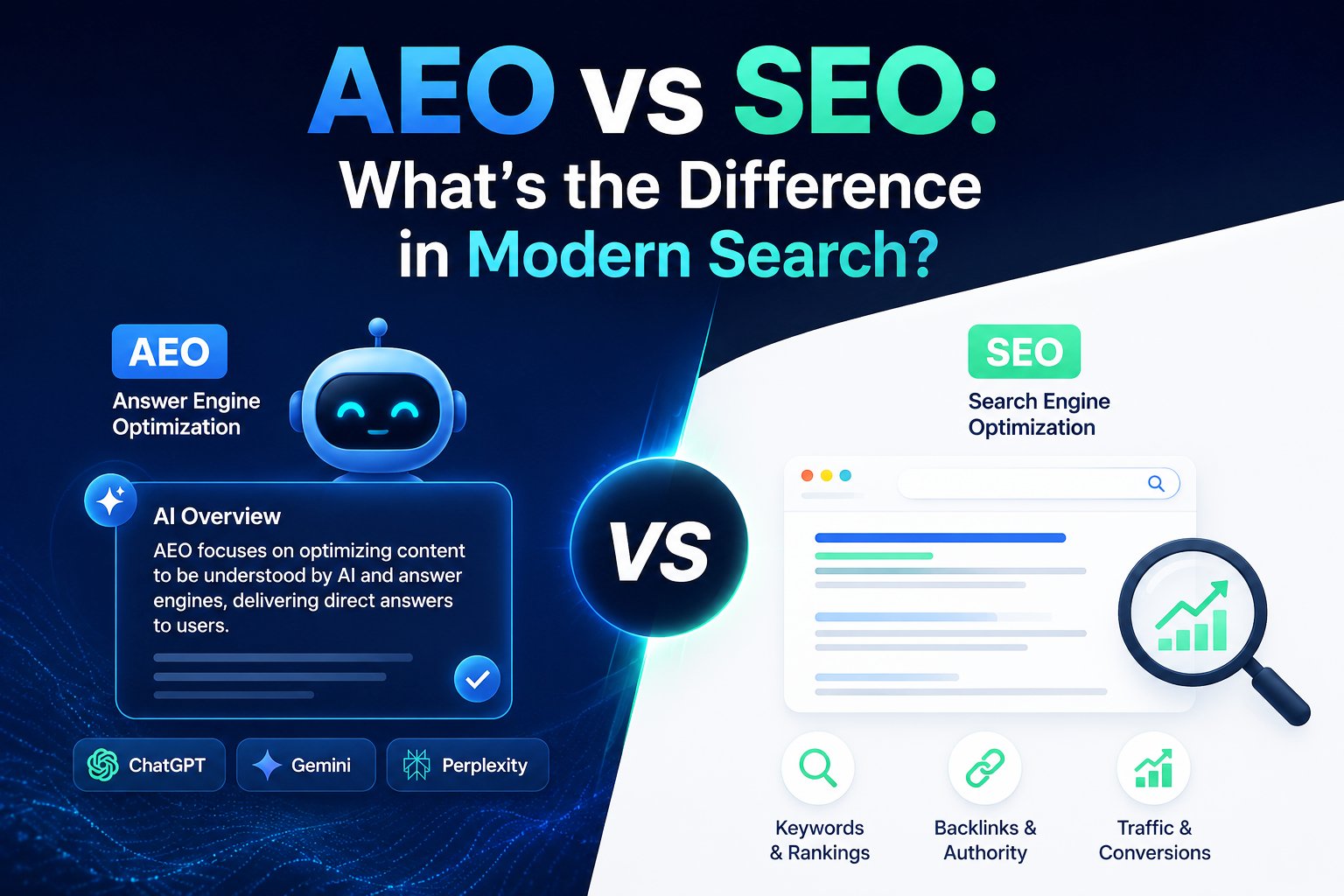
AEO (Answer Engine Optimization) is the process of optimizing content so AI systems and answer engines can easily extract, understand, summarize, and cite it as a direct answer.
Instead of only ranking webpages, AEO focuses on:
- featured snippets
- AI-generated answers
- voice search results
- conversational search responses
- AI overview citations
Modern answer engines include:
- ChatGPT
- Google AI Overviews
- Gemini
- Microsoft Copilot
- Perplexity AI
- Siri
- Alexa
These systems do not simply rank pages. They retrieve, process, compare, and synthesize information from multiple sources.
That means content must be:
- machine-readable
- semantically clear
- concise
- trustworthy
- structured for extraction
AEO vs SEO: The Core Difference
| SEO | AEO |
|---|---|
| Focuses on rankings | Focuses on answers |
| Optimizes webpages | Optimizes information extraction |
| Targets search engines | Targets AI systems and answer engines |
| Relies heavily on keywords | Relies heavily on semantics and entities |
| Encourages clicks | Sometimes removes clicks |
| Blue-link visibility | AI-generated visibility |
| SERP optimization | Conversational search optimization |
| Ranking-focused | Retrieval-focused |
Why AEO Matters in Modern Search
Search behavior is changing dramatically.
Users increasingly ask:
- conversational questions
- long-tail queries
- follow-up questions
- voice-based searches
Instead of:
“best local SEO strategy”
People now ask:
“What’s the best local SEO strategy for small businesses in 2026?”
AI systems are designed to answer these naturally.
This changes how content should be written.
The Rise of AI Search
Modern search engines now combine:
- search indexing
- machine learning
- NLP
- generative AI
- semantic retrieval
Google’s AI Overviews already summarize information directly in search results.
ChatGPT and Gemini answer user questions conversationally without users necessarily visiting websites.
This means visibility now depends on:
- extractable answers
- semantic understanding
- trust signals
- topical authority
How AI Search Engines Actually Read Content
Traditional search engines mainly relied on:
- keywords
- links
- metadata
AI search systems use:
- embeddings
- vector search
- entity relationships
- semantic matching
- contextual understanding
They analyze:
- meaning
- structure
- expertise
- readability
- topical coverage
This is why generic AI-written content often fails.
Modern AI systems prioritize:
- useful answers
- structured formatting
- factual clarity
- real expertise
What Makes Content AEO-Friendly?
1. Direct Answers First
AEO content immediately answers the question near the top of the section.
Example:
What Is AEO?
AEO (Answer Engine Optimisation) is the process of optimising content so AI systems can extract and present it as a direct answer in conversational search results, featured snippets, and AI-generated summaries.
That short definition is highly retrievable.
2. Question-Based Headings
Use headings like:
- What Is AEO?
- How Does AI Search Work?
- Why Is Semantic SEO Important?
This aligns with:
- voice search
- People Also Ask
- AI conversational queries
3. Short Paragraphs
Large walls of text reduce retrieval quality.
Best practice:
- 2–4 lines per paragraph
- one idea per paragraph
4. Structured Formatting
Use:
- bullet points
- numbered lists
- tables
- FAQs
- summaries
AI systems extract structured content more effectively.
5. Entity Optimisation
Mention:
- brands
- tools
- technologies
- concepts
Example:
Instead of:
“this AI tool”
Use:
“ChatGPT”, “Gemini”, or “Perplexity AI”.
Entities help AI systems understand context.
How SEO and AEO Work Together
AEO does not replace SEO.
In reality:
AEO is evolving from SEO.
Without SEO:
- your content may not get indexed properly
- your authority remains weak
- AI systems may never discover your pages
Without AEO:
- your content may rank
- but fail to appear in AI-generated answers
The best strategy combines both.
Modern SEO Strategy Requires Both SEO and AEO
Traditional SEO Helps You:
- rank webpages
- gain traffic
- build authority
- improve discoverability
AEO Helps You:
- appear in AI answers
- win featured snippets
- dominate voice search
- increase brand mentions in AI systems
The future belongs to brands that optimize for both humans and machines.
Best Practices for Combining AEO and SEO
Use Topical Clusters
Build pillar pages supported by related subtopics.
Example cluster:
- What Is AEO?
- AEO vs SEO
- How AI Search Works
- Semantic SEO Guide
- Featured Snippet Optimization
- NLP SEO Strategies
- AI Overview Optimization
This builds topical authority.
Optimise for Conversational Search
Target:
- long-tail keywords
- natural language queries
- follow-up questions
Add FAQ Sections
FAQs improve:
- snippet eligibility
- AI extraction
- voice search performance
Use Schema Markup
Important schema types:
- FAQ schema
- Article schema
- HowTo schema
- Organization schema
Structured data helps machines understand content.
Improve EEAT Signals
Google and AI systems increasingly value:
- expertise
- authority
- trustworthiness
- experience
Add:
- author bios
- research
- examples
- original insights
Common SEO Mistakes in the AI Search Era
Keyword Stuffing
Modern AI systems understand semantics.
Overusing keywords reduces quality.
Writing for Algorithms Only
AI systems increasingly evaluate:
- usefulness
- readability
- trust
- intent satisfaction
Ignoring Semantic Search
Modern search is entity-driven.
Your content must cover:
- related concepts
- contextual topics
- supporting information
Thin Content
Short, shallow articles rarely become AI citations.
Topical depth matters more than ever.
Will AEO Replace SEO?
No.
SEO is still the foundation of online visibility.
However, SEO alone is no longer enough.
The future of search is hybrid:
- traditional ranking systems
- AI-generated answers
- semantic retrieval
- conversational interfaces
Businesses that adapt early will gain massive visibility advantages.
How to Optimise Content for ChatGPT, Gemini, and AI Search
Write Answer-First Content
Provide immediate answers before detailed explanations.
Use Semantic Relevance
Cover the topic comprehensively instead of repeating one keyword.
Build Topical Authority
Create connected content clusters around your niche.
Make Content Easily Extractable
Use:
- headings
- bullets
- summaries
- concise answers
Demonstrate Real Expertise
Generic content is increasingly ignored by AI systems.
Include:
- examples
- testing
- insights
- real-world experience
Frequently Asked Questions
What is the biggest difference between AEO and SEO?
SEO focuses on ranking webpages in search engines, while AEO focuses on helping AI systems extract and present content as direct answers.
Is AEO important for Google AI Overviews?
Yes. Google AI Overviews rely heavily on structured, semantically clear, answer-focused content.
Does AEO help ChatGPT visibility?
Yes. Content that is authoritative, structured, and easy to summarize has a higher chance of being referenced or retrieved by AI systems like ChatGPT.
Is traditional SEO still relevant?
Absolutely. Technical SEO, authority building, indexing, and content quality remain critical foundations for visibility.
What type of content performs best in AI search?
The best-performing content is:
- structured
- concise
- semantically rich
- trustworthy
- answer-focused
- comprehensive
What are the most important AEO ranking factors?
Key AEO factors include:
- direct answers
- semantic relevance
- entity optimization
- structured formatting
- topical authority
- EEAT signals
- schema markup
Conclusion:
The search landscape is evolving from keyword retrieval to answer generation.
Traditional SEO helped users find webpages.
AEO helps AI systems deliver the best answer instantly.
Modern brands must now optimize for:
- search engines,
- AI systems,
- conversational interfaces,
- and semantic retrieval models simultaneously.
The winners in modern search will not simply publish more content.
They will publish:
- clearer content,
- more structured content,
- more trustworthy content,
- and more answer-focused content.
The future of visibility belongs to businesses that understand both SEO and AEO together.